Today, the source of value for fashion accessories brands is no longer limited to pure craftsmanship and materials; Wear to Be has increasingly become a key factor driving growth: when a piece of jewelry accurately echoes aesthetic preferences, when a bag fully expresses an attitude toward life, when a pair of glasses conveys the current mood—relaxed, sharp, or gentle—it is enough to become the real reason users feel compelled to place an order.
The "ideal self" is not fixed but naturally changes with life stages—at 20, people prefer "exploration and expression"; at 30, they "desire achievement"; at 40, they care more about "self-mastery"—therefore, consumer needs also flow dynamically. More importantly, users often cannot clearly describe what their "ideal self" looks like; instead, they externalize deep psychological needs as an "emotion."

However, emotion is not something users say directly. No one types into a search box, "I want a feeling of being seen"—but they will search "what to wear for autumn commutes to look refined," and they will linger for a long time under a post about "what to gift yourself after a promotion." Emotion is hidden in users' search terms, in the content they like, and in the moment of impulse when they are willing to repost. Reading these is what it means to truly understand the real reason for purchase.
The real challenge brands face is: emotion is emotional and fluid; advertising decisions are rational and need numerical backing. Between the two lies a huge translation gap. Whoever can translate "users' emotions" into "brand strategy" holds the key to the fashion accessories business in this era. This is exactly what China's leading lifestyle interest community—Xiaohongshu—is systematically doing.
With 400 million monthly active users, Xiaohongshu is the first scene of beauty, with over 90% of content user-generated. But what truly makes it valuable to fashion accessories brands is not just its scale—it is the way users express themselves here. They are not just searching for products; they are discussing life scenarios, aesthetic preferences, and life moments—a note about jewelry may be born from reflections after an art exhibition, or from a sigh of emotion after a workplace promotion. These cross-expressions are an emotional ore that is hard to replicate on other platforms.
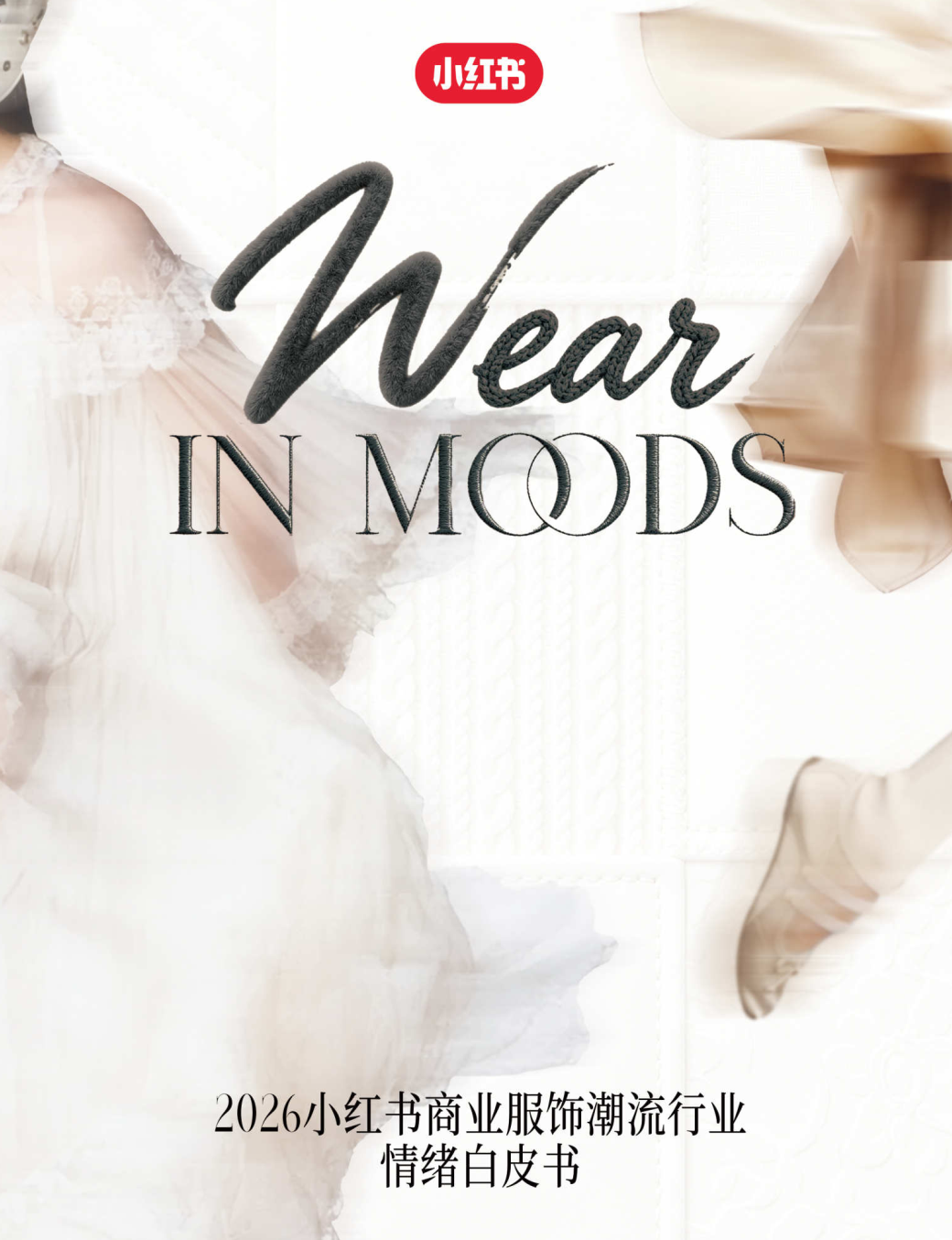
Recently, coinciding with the key node of "autumn new arrivals," Xiaohongshu officially released the "2026 Xiaohongshu Commercial Fashion Accessories Industry Emotion White Paper" at the "2026 Xiaohongshu Commercial Fashion Accessories Industry Private Sharing Session" and presented a series of latest research findings: its self-developed AI quantification tool, by mining over 780,000 notes, has distilled 95 emotion models and extracted ten major emotion trends—turning the abstract proposition of "understanding people" into a practical strategic path for brands from product development to content communication.
Emotion Insights Anchor the Birth Direction of "Hero Products"
When launching new products, the first question brands face is always: why would users buy it? The "reason to buy" is exactly the answer to "who the user wants to become." The difficulty lies in two aspects: first, this answer is often hidden in users' unspoken emotions; second, brands need to see both the outline of "a group of people" and land on "each specific individual"—after all, from emotional touch to purchase decision, people at different life stages and in different life scenarios have different paths.
At the time of "autumn new arrivals," Xiaohongshu directly addresses brands' pain point of user insight, transforming data-driven emotional insights into a "tactical guide" that brands can reference:
Through exclusive AI applications, Xiaohongshu digs deep into consumer decision psychology, from lifestyle to decision factors.The platform has accumulated over3,200 industry decision-factor audience tags, from scenarios to situations, mining120 finely detailed scenarios, from function to emotion, and then distilling95 emotion models.The "2026 Xiaohongshu Commercial Fashion Accessories Industry Emotion White Paper" and the highly targeted "2026 Top Ten Emotion Trends" for the fashion accessories industry present users' hidden "reasons to buy" in a data-driven way, helping brands clearly understand the emotional preferences of people at different life stages and life states.
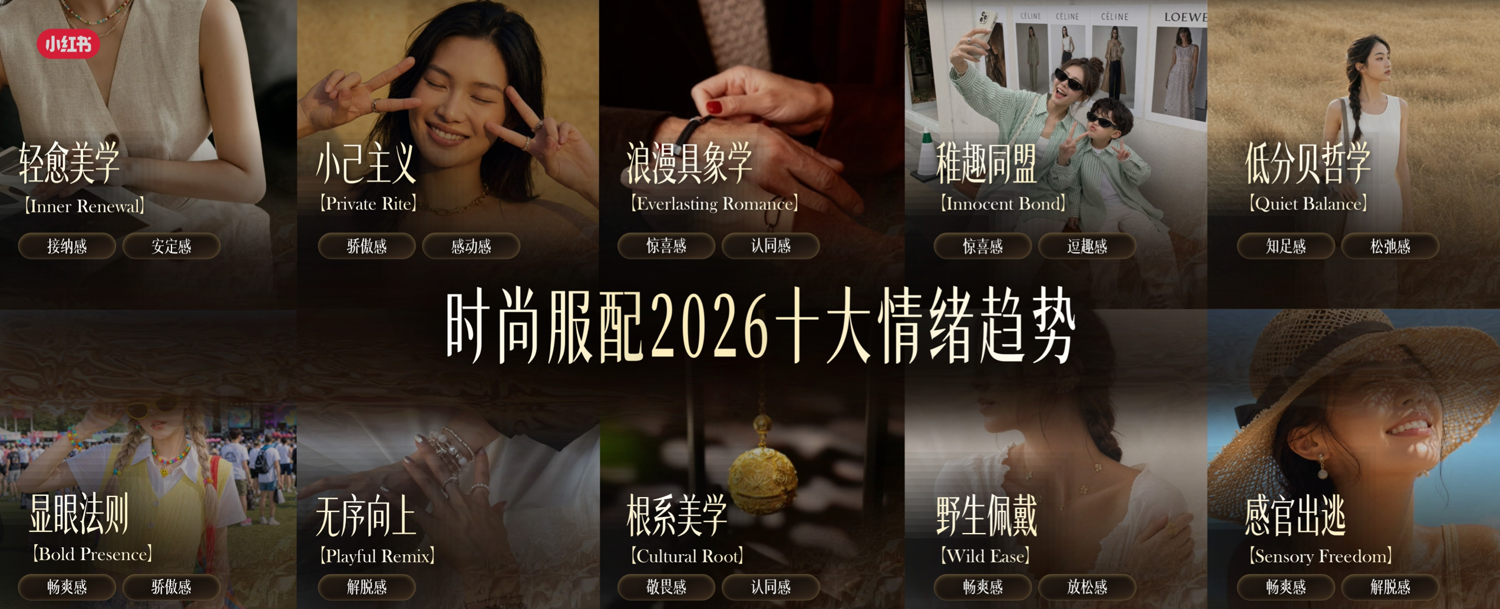
At the time of "new arrivals," "product selection" and "advertising placement" are the two core issues brands care about. The "Fashion Accessories 2026 Top Ten Emotion Trends," by quantifying and grounding users' diverse emotional demands, directly provides brands with a "matchmaking" solution.
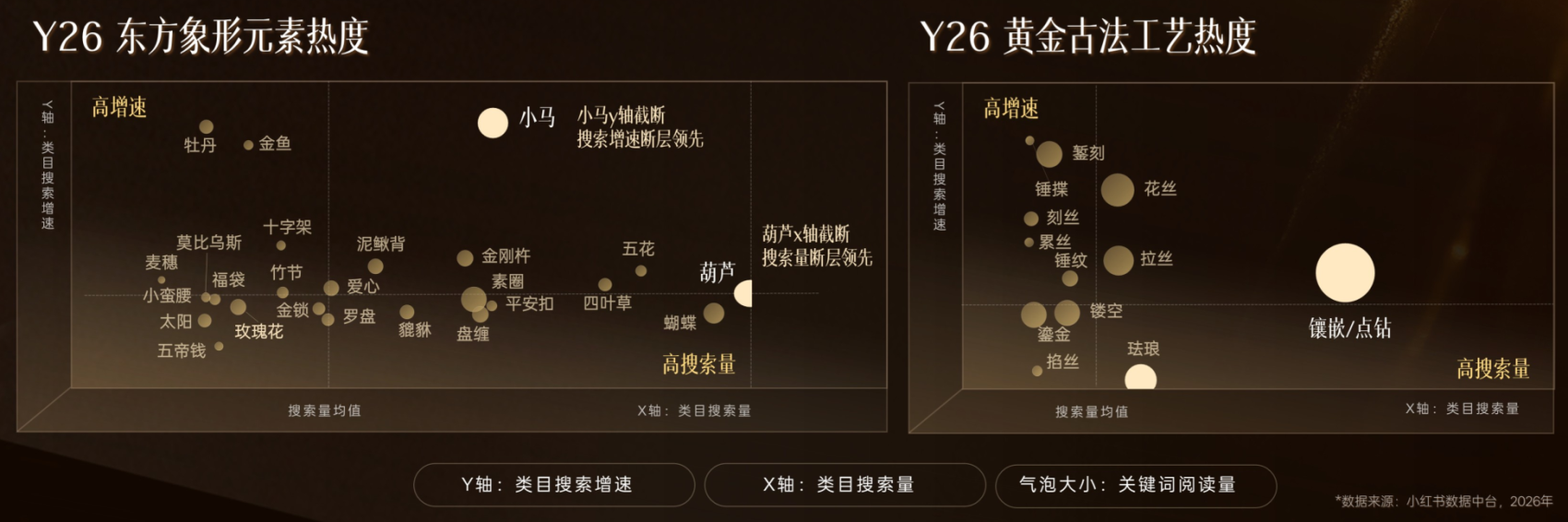
For example, in product selection, the "Root Aesthetics" trend clearly presents the growth rate of "ancient gold" craftsmanship and the popularity distribution of "Eastern pictographic elements." It can be seen that in terms of craftsmanship, inlay/stone setting ranks high in both readership and search volume, while the "gourd" element leads by a landslide in search volume. This also intuitively explains why many products combining these two elements have quickly become popular in the past year—Xiaohongshu creates a closed loop between trend insights and hit-product logic.
In advertising placement, Xiaohongshu links the four dimensions of "emotion-audience-product-style," directly anchoring customer group direction and content focus for brands:
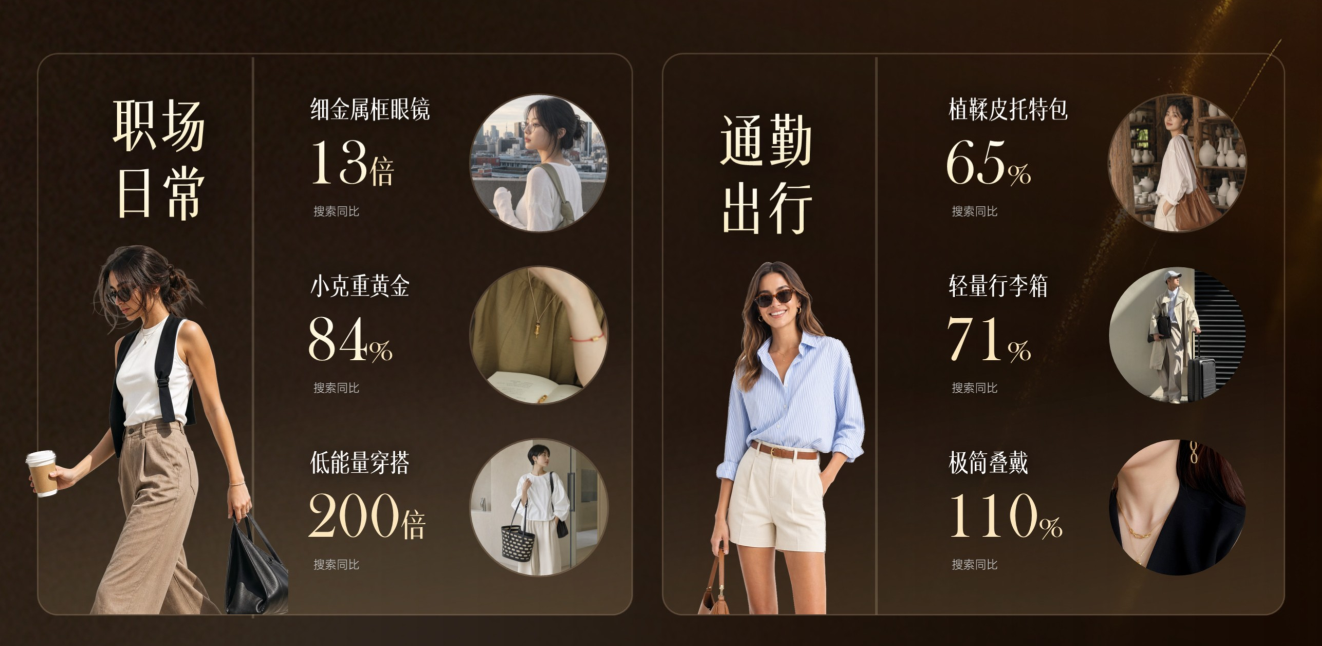
For example, the widely discussed "sense of relaxation" falls under the "low-decibel philosophy" trend and is highly compatible with "sense of contentment." Data shows that this trend is strongly correlated with the workplace women group; at the product level, thin metal-frame glasses, lightweight gold, and vegetable-tanned leather tote bags are strongly bound to it; at the style level, it shows high correlation with "minimalist layering" and "low-energy dressing."
Using the Right Emotions to Break the "Ceiling" of Brand Growth
Understanding "who they want to become" is only the starting point. Users will not remember a brand forever because of one moment of excitement—true brand equity comes from continuously accompanying a person through the process of "becoming." When users have already developed interest in a brand and desire to be further seen and understood, whoever can steadily meet this expectation with high-density content can complete the leap from "being seen" to "being chosen and remembered," thereby building long-term brand value and breaking the "ceiling" of brand growth.
This is evidenced by HEFANG, a strong Chinese jewelry brand.
HEFANG excels at transforming everyday objects into products that combine personality and artistry through playful design language, and has now grown into a rare designer jewelry brand that balances creativity and commerce. However, the more unique the creative language, the more it needs a like-minded audience to "read" it—"finding the right people" becomes the crucial first step.
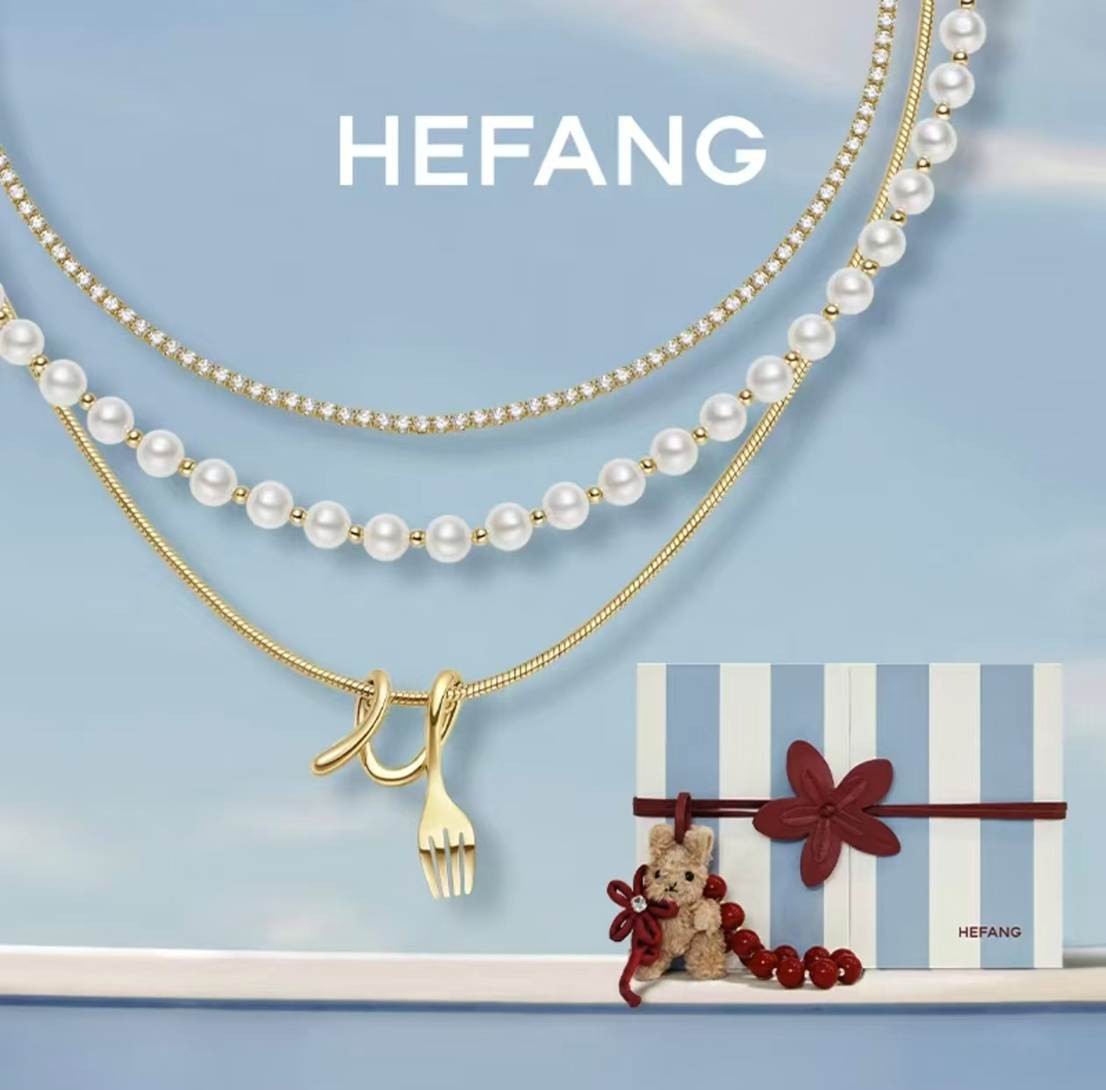
Through first-party data analysis, HEFANG on the Xiaohongshu platform portrays buyer profiles into three categories: "high-intellect climbers," "luxury self-pleasers," and "artistic aesthetes," and matches different content themes for these three groups, implementing "saying the right words"—making every "brand message" land precisely in what users "want to hear":
For example, for "high-intellect climbers," the brand uses female growth topics such as "no longer entering the evaluation system," which aligns with the group's sense of exhilaration and expectation; for "luxury self-pleasers," the brand uses lifestyle topics such as "a lazy afternoon with girlfriends" to highlight the group's preferred sense of relaxation and pleasure.
After the brand knows "who to reach" and "what to use to reach them," "how to reach them" becomes particularly important. After analyzing the platform's existing note content and performance, the brand found that: compared with the later stages of the decision journey—"comparison" and "conversion"—the brand needed to increase the proportion of content at the "awareness" level, and therefore allocated a higher proportion of top-tier influencers in this area.
Together with the brand's new product launch, this combined strategy achieved remarkable results: first-month GMV of new products exceeded 4 million, with new customers accounting for 55%—meaning more than half of purchases came from people who had never bought HEFANG before. More notably, the LTV of these new customers reached 1.2 times that of existing customers. Being able to precisely find the "right people" and carry out targeted advertising is more valuable than simply expanding exposure.
The value of commercial conversion is not limited to sales itself; it boosts the brand's momentum in all aspects—especially for "growth-stage" brands like HEFANG that already have a certain level of recognition in the industry. Every precise reach and conversion deepens brand awareness, reinforces the reputation barrier, and in turn feeds a new round of growth, building a "flywheel" of brand value. In this process, from "choosing the right people" and "saying the right words" to "using the right methods," Xiaohongshu makes emotion insights an important thread for driving growth and achieving long-term operations.
Omnichannel Linkage Brings "Emotional Value" to Fruition
"Fulfilling users' ideal selves," if it happens only once, cannot be called a business. It needs to be steadily carried and repeatedly delivered to grow into a long-term relationship between brand and user. This is the meaning of "from seeding to harvest": letting every "being seen" turn into a real transaction, and letting every transaction set the stage for the next encounter. The connecting chain exists both online and in offline stores that were previously difficult to measure, and is integrated with deeper brand strategy.
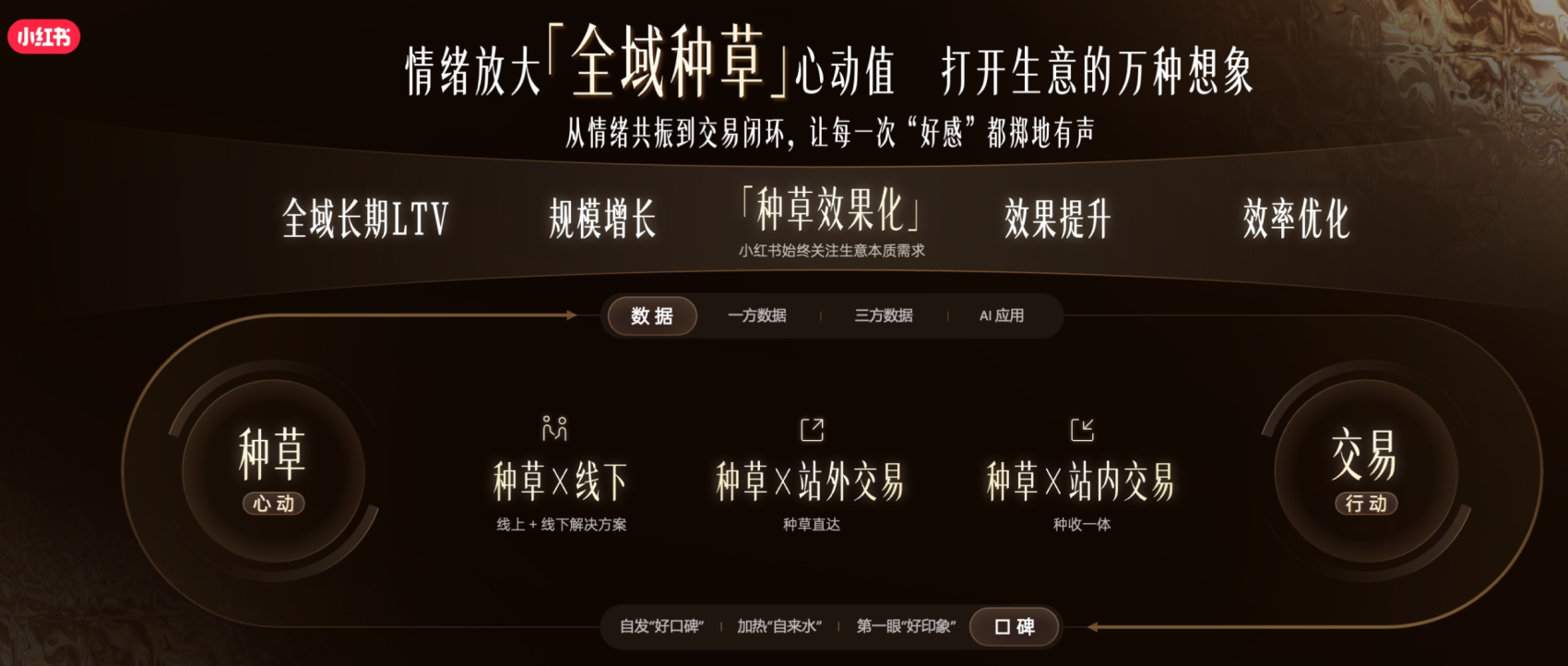
Online, fashion accessories brands have different "main battlegrounds" based on their own characteristics. Xiaohongshu, with its advantage in the concentration of quality-life-seeking people, opens up a highly valuable "second growth field" for brands: currently, Xiaohongshu's closed-loop e-commerce has over 200 million monthly purchase-intent users, with new customers accounting for 95%, becoming an important source of vitality for brands' CRM systems.
In recent years, the opening of off-platform transaction links has also made it convenient for brands to track seeding effects across the online universe: the number of customers directly reached through Xiaohongshu's mid-platform seeding increased by 435%, and the average ROI of seeding direct reach over 30 days exceeded 10, driving over 237 single products with million-level GMV. (Data: Xiaohongshu Data Mid-Platform 2024.1.1–2025.9.30)
Offline stores, as the most critical retail touchpoint for fashion accessories brands, have always been difficult to measure in terms of effectiveness. In the past two years, the rapidly growing KOS (Key Opinion Sales) community on Xiaohongshu, combined with the platform users' natural ROPO mindset (Research Online, Purchase Offline, i.e., research online, purchase offline), is systematically revitalizing this traditional monitoring blind spot.
Today, offline stores not only smoothly承接 online purchase intent but also extend to more diverse functions such as Xiaohongshu store exploration check-ins, new product experiences, and member activities—face-to-face real interactions can effectively feed the production and dissemination of online UGC content, and release more explosive power at key brand moments such as flagship store openings, celebrity announcements, and holiday marketing.
Conclusion
Emotion is not the endpoint of expression but the entry point to understanding people. In the next stage, competition in the fashion accessories industry is essentially a contest of "depth of understanding people." The key for brands to be "one step ahead" is the ability to understand "who users want to become right now" in specific scenarios.
At this important tactical node of "autumn new arrivals," Xiaohongshu truly helps brands turn "understanding people" from an intuitive feeling into an executable system: with an objective external perspective, it helps brands break out of established cognitive frameworks, discover blind spots and opportunities "they cannot see themselves," and avoid directional deviations and resource waste caused by misjudgment. The platform's high-quality community tone, well-developed operating mechanisms, and high-density fashion audience ecosystem allow the entire chain from insight to conversion to flow smoothly.
Emotion is the entry point, insight is the method, and operation is the result. Ultimately, what Xiaohongshu gives fashion accessories brands is a sustainable competitive barrier—letting growth take root in user minds and letting brands grow through real connections. Brand and performance integration is no longer a slogan but a long-term practice in a strategic battleground.
| Image source: provided by Xiaohongshu; HEFANG official Xiaohongshu account; Unsplash
| Editor: LUXE.CO